The IAAS are delighted to announce the winner of this year’s WTM Riches Essay Prize. Christina McCambridge, an MA student at Queen’s University Belfast, has been selected as the overall winner for her essay entitled “‘Music dismantles history’: A Postcolonial Reading of Musicality and Temporality in the Chamber Poetics of T.S. Eliot and Ishion Hutchinson.”

The WTM Riches Essay Prize is awarded annually for outstanding work in any area of American Studies by undergraduate students and students in the first year of postgraduate studies. More information, including past winners, can be found here.

Heidelberg Center for American Studies 20th Annual Spring Academy Conference

Heidelberg, Germany, 20–24 March, 2023

*Call for Papers * 

The twentieth HCA Spring Academy on American Culture, Economics, Geography, History, Literature, Politics, and Religion will be held from March 20-24, 2023. The Heidelberg Center for American Studies (HCA) invites applications for this annual one-week conference that provides twenty international Ph.D. students with the opportunity to present and discuss their Ph.D. projects.

The HCA Spring Academy invites participants to work closely with experts in their respective fields of study and offers workshops held by visiting scholars.

We encourage applications that pursue an interdisciplinary approach and range broadly across the arts, humanities, and social sciences. Papers can be presented on any subject relating to the study of the United States of America. Possible topics include American identity, issues of ethnicity, gender, transatlantic relations, U.S. domestic and foreign policy, economics, as well as various aspects of American history, literature, religion, geography, law, musicology, and culture. Proposals should include a preliminary title and run to no more than 300 words.

Participants are requested to prepare a 20-minute presentation of their research project, which will be followed by a 40-minute discussion. The presentations will be arranged into ten panel groups.

In addition to cross-disciplinary and international discussions during the panel sessions, the Spring Academy aims at creating a pleasant collegial atmosphere for further scholarly exchange and contact.

Accommodation will be provided by the Heidelberg Center for American Studies.

Thanks to a small travel fund, the Spring Academy is able to subsidize travel expenses for participants registered and residing in soft-currency countries. Scholarship applicants will need to document the necessity for financial aid and explain how they plan to cover any potentially remaining expenses. In addition, a letter of recommendation from their doctoral advisor is required.


START OF APPLICATION PROCESS:                                          August 15, 2022

DEADLINE FOR APPLICATIONS:                                                November 15, 2022

SELECTIONS WILL BE MADE BY:                                                January 2023

PLEASE USE OUR ONLINE APPLICATION SYSTEM:             www.hca-springacademy.de

MORE INFORMATION:                                                                 www.hca.uni-heidelberg.de

FOR FURTHER QUESTIONS:                                                        springacademy@hca.uni-heidelberg.de


SHOULDN’T YOU BE WRITING?!

WRITE ALONG WITH OUR POSTGRADUATE MEMBERS!

Starting August 30th, the Postgraduate Caucus co-chairs of the IAAS, Janice Deitner and Andrew Clarke, will be hosting a write along session on Discord. 

Information on the poster opposite. You can drop us a line at our Facebook page or on Twitter too for more info! @TheIAAS


How might we understand the at times fraught, at times generative relationship between poetry and criticism?

What does it take for poetry to be, as Matthew Arnold proclaimed, “a criticism of life”, or as Audre Lorde insisted, “a vital necessity… toward survival and change?” And what steps must we take to, in the words of Adrienne Rich, “enter an old text from a new critical direction”?

How might epigraphs function as critical measures of the poem which follows? Is there a different rhythm for reading reviews in the same magazine as we encounter poems? How does the poet-critic negotiate the demands of both roles in relation? And what work can poetry criticism do to bring about cultural awareness and even change?

One day symposium

Maynooth University, 21st March 2022.


Our chiasmus takes account of the symbiosis that exists between poetry and criticism, seeking to explore the reciprocity and tensions therein. Poems such as Alexander Pope’s An Essay on Criticism (1711), Anne Carson’s Glass Essay (1994), W.H. Auden’s The Sea and The Mirror: A Commentary on Shakespeare’s The Tempest (1944), and Vahni Capildeo’s reviews-in-verse in Skin Can Hold (2019) melt the distinctions we usually make between verse and prose, poetry and criticism, into air. Essays such as Sandeep Parmar’s ‘Not a British Subject: Race and Poetry in the UK’ (2015) and ‘Still Not a British Subject: Race and UK Poetry’ point to the work to be done in addressing the structures of whiteness in Anglophone poetry criticism, and “expanding the definition of innovative or avant-garde to account for challenges to the expressive and individual lyric mode posed by poets of colour.”


Whatever the relationship between poetry and criticism, it is one of vital importance, shaping how poems are written and received, canons formed, interrogated, and reformed, and poetic energies unleashed in both verse and prose.

This one-day symposium on March 21st at Maynooth University, Ireland, seeks to address such questions, and more, bringing together scholars working on poetry, poetics, literary studies, and other relevant areas. We especially welcome work from BAME/BIPOC scholars, poets and writers.

We are honoured to host Professor Sandeep Parmar and Dr Mary-Jean Chan as our joint plenary speakers.

While we hope this symposium will be in person (abiding by the Covid-19 measurements required by the Government of Ireland, which includes mandatory mask-wearing), we reserve the right to pivot online in the interests of public safety.

Please send us an abstract along with a brief biography to Dr Karl O’Hanlon and Dr Catherine Gander at poetryascrit@gmail.com by January 15th 2022.

Possible topics might include, but are not limited to:


  • Critical poetic forms (e.g. poetic essays, odes and palinodes, elegies, epistles, parody, burlesque, reviews-in-verse)
  • Public-facing critical cultures (platforms, media, audience)
  • Poetry criticism and race
  • Poetry criticism and gender
  • Poetry criticism and ‘craft’
  • Poetry responding to criticism and vice versa
  • The social function of poetry
  • Reviewing and rhetoric: critical arguments in the ‘poetry wars’
  • Canon formation, occlusion and marginalisation
  • The role of the poet-critic
  • Lyric subjectivity and new lyric studies
  • The roles of various reviewing platforms
  • Literary politics, self-fashioning and critical reputations
  • Prose criticism and style

Get Started


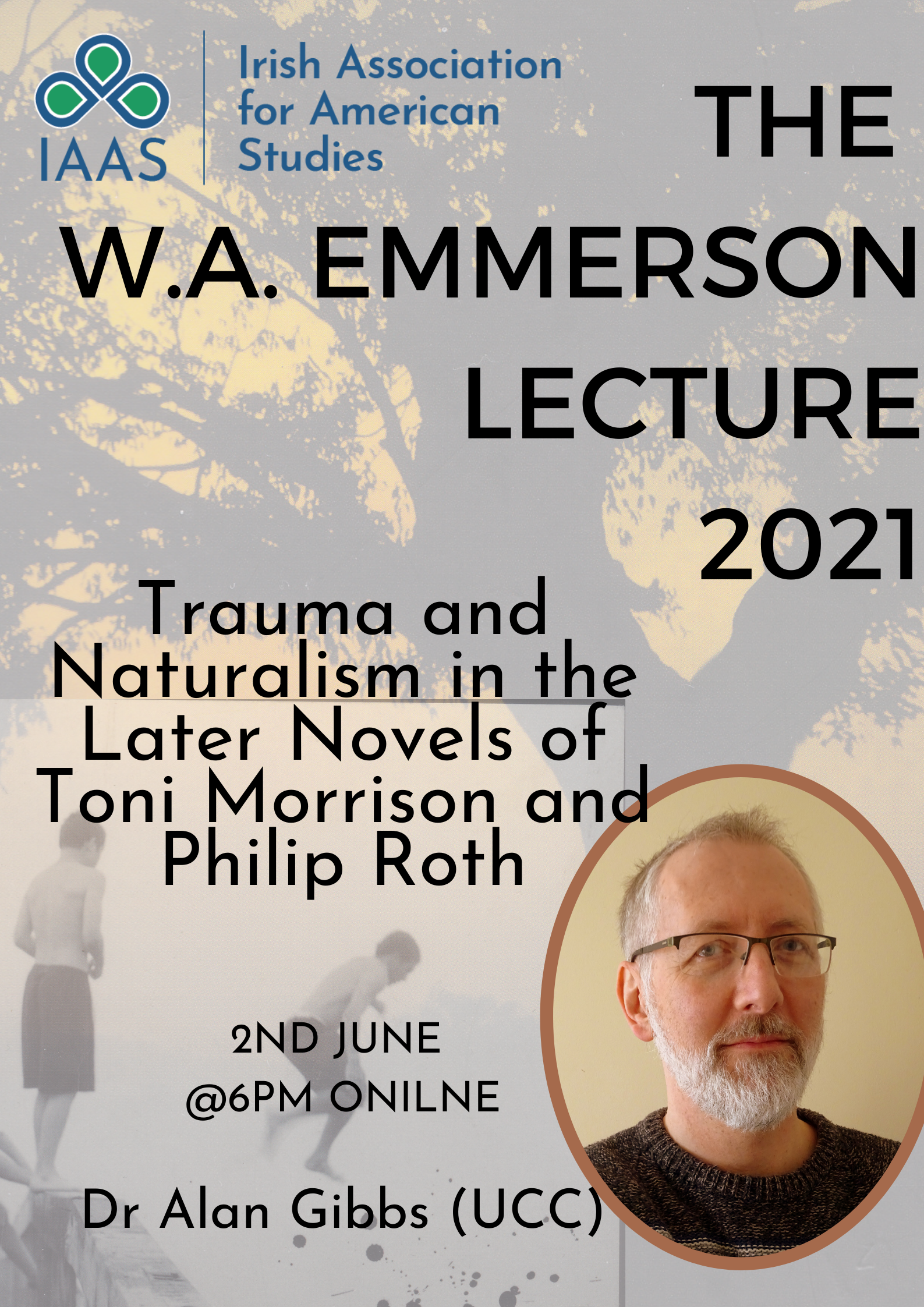
‘Trauma and Naturalism in the Later Novels of Toni Morrison and Philip Roth’

Dr Alan Gibbs

The IAAS was honoured to host Dr Alan Gibbs for the 2021 W. A. Emmerson lecture on June 2nd. 

The lecture was delivered online, followed by a lively and illuminating Q&A. It can be watched back via our YouTube channel. 

Many thanks again to Dr Gibbs for such a fantastic lecture!

Watch the lecture


The Rothermere American Institute and Mansfield College are seeking to recruit a Junior Research Fellow in Nineteenth-century United States History. The post is fixed-term for two years.

It is an opportunity for an early career historian to develop their own research and publications while also working with Professor Adam Smith to develop a new collaborative research project with a strong potential for external funding. The Research Fellow will have expertise related to the problem of political legitimacy in the nineteenth-century United States. Their research interests may include: the language, ideas or practice of politics; the intellectual history of the concept of political legitimacy; legal history; insurrections, riots and rebellions; or comparative or transnational perspectives on American political development. The Research Fellow will organise a seminar series at the RAI on a theme connected to their own research while contributing more generally to the academic life of the Institute.


Alongside a completed, or close to completion, doctorate in a relevant subject, some undergraduate teaching experience and specialist knowledge in the areas of research specified, the Junior Research Fellow will have the ability to manage their own academic research and will have a least one research publication. Excellent communication skills, professionalism, and a proven track record of working with others are essential to the role, as is the ability to contribute ideas for a new research project. Experience of writing grant applications will be an advantage.

Deadline for applications is 12:00 noon on Friday 23 April 2021.

See here for more details.

JOB DESCRIPTION

The School of English, Irish and Communication is seeking to recruit a Teaching Assistant in English, specializing in American literature. The duration of the contract is limited to 10 months and will run from 1 September 2021 to 30 June 2022. However, it may be renewed for one further period only, not exceeding 10 months. They will report to the Head of the Department.

The successful candidate will be expected to make a substantial contribution to undergraduate and MA teaching in English literature in the area of American literature. Interested candidates must have a Doctoral degree (level 10NFQ) in English or related discipline from an accredited research university, on a topic related to American literature. They should have a minimum of one year’s experience in teaching literature at college/university level with at least one peer-reviewed publication. Applicants must confirm that they are currently eligible to work in Ireland. Applications by candidates who are not eligible to work in Ireland unfortunately cannot be processed.

The School of English, Irish and Communication is a large and vibrant unit within the Faculty of Arts, Humanities and Social Sciences and plays a vital role in promoting quality research, teaching, and learning at the University of Limerick.

See here for further details and to apply. 


The Irish Association for American Studies is calling for nominations for the following positions on the Executive Committee:


Secretary

Ordinary Member x2

Postgraduate caucus co-chair


Please note that in accordance with the ethos of the IAAS, the committee especially welcomes nominations for members from under-represented backgrounds and ethnicities.


Ideally, we are looking for executive committee members who have experience and familiarity with our activities, ideals, and membership. There are many ways to get involved with the IAAS, and new members are very welcome at association events.


  • Nominations must be made by a member or members of the IAAS
  • We accept self-nominations
  • All executive committee members, aside from fulfilling duties specific to their role, will be expected to attend all IAAS committee meetings throughout the year (January, April [AGM], June, September, November [PGR conference])
  • Information on the full requirements of the role(s) will be made available on request
  • The positions will be elected by members of the IAAS during the AGM (10th April 2021)
  • Please email your nominations to info@iaas.ie by 1st April 2021


The IAAS is a proud sponsor of #Douglassweek, a week-long series of special events and activities celebrating Frederick Douglass’s trip to Ireland in 1845. All events are free and online, and information, including registration, can be found at www.douglassincork.com


#Douglassweek is the brainchild of Dr Caroline Schroeter, and the result of over a year’s work by a dedicated team of scholars, including the IAAS’s own Dr Schroeter, Dr Tim Groenland, and Sarah McCreedy.