UCD Clinton Institute and the Roosevelt Institute Symposium

‘Progressivism in America, Past, Present and Future’

8th and 9th November 2013 

Leading figures from academia such as Joseph Stiglitz and Alan Brinkley, and from the media including E.J. Dionne, Christopher Caldwell, Jonathan Alter and Fintan O’Toole, will gather to discuss progressive politics in the United States.  Topics will include the legacies of Presidents such as Woodrow Wilson, Franklin D. Roosevelt, and Bill Clinton; contemporary challenges such as climate change, and terrorism; debates about Barack Obama’s tenure; and prospects for the future.

Full programme available on http://www.ucdclinton.ie/ProgressivismSymposium

Registration fee €25, students free

To register please email Catherine.Carey@ucd.ie

 UCD Clinton Institute for American Studies 
 
Symposium  
 
‘The Ongoing Struggle for Civil Rights: The United States, Northern Ireland and Worldwide’
 
Saturday 5th October 2013
 
The Clinton Institute for American Studies and  the John Moore Newman Fellowship  presents a one-day symposium on the topic of comparative civil rights.  Building on existing research at the Clinton Institute, this event seeks to discuss, analyse and attempt to draw analogy between historic and contemporary civil and human rights campaigns both in Ireland and internationally.
 
Speakers include:
 Bernadette McAliskey(Socialist Republican Political Activist)  
Maryam al Khawaja (Bahrain Centre for Human Rights)
Minnijean Brown Trickey (Little Rock Nine)
Brian Dooley,(Human Rights First)
Dr. Máiréad Collins,
Prof. Peter Ling (University of Nottingham), 
Dr. Rita Sakr (University of Kent),
Dr. Gareth Mulvenna (QUE),  
Dr. Stuart Ross
 Dr. Niall O Dochartaigh (NUIG)  
Prof. Fr. Thomas Murphy (Seattle University) 
 
Further information available on http://www.ucdclinton.ie/CivilRightsSymposium
 
Registration fee €10 and students free (includes refreshments and lunch).  To register please email Catherine.Carey@ucd.ie


‘Homeward Bound’: Nation, Belonging and the American Home

BAAS and IAAS Postgraduate Conference, 7-8th December 2013

University of Nottingham

 Keynote speakers:

Professor Bridget Bennett (University of Leeds)

Professor Randall Woods (University of Arkansas)

The home has long served as a powerful signifier of American culture and identity, from the colonial frontier log cabin constructed to resist the rigors of a New World, to the suburban house synonymous with affluence and spiralling consumerism. The home is a space in which the politics of domesticity and sexual difference is made concrete; where gender roles are continually contested; and where a sense of belonging and unbelonging helps to define the roots of a community whether local, national or transnational. The home is a signifier of nation, of class, race and ethnicity and it is a location that inspires musicians, poets, artist and writers.  Notions of a besieged homeland texture the language of international relations, whilst a banking crisis and the foreclosures that followed rearticulated the centrality of the home within American policy. This conference interrogates a symbol that lies at the foundation of America itself.

 ‘Homeward Bound’ is a two-day interdisciplinary conference for postgraduate students with an interest in North America and whose research engages with history, literature, critical theory, visual culture, architecture, media studies and political theory. The conference invites proposals for 20-minute presentations on any aspect of our broad theme. The topics include, but are not limited to:

 –           Urban, suburban, exurban and rural homes/spaces

–           Domesticity, gender, private/public spheres

–           The home as a historical construct

–           The non-familial family and concepts of legitimacy

–           Regions, regionalism and transnationalism

–           Morality, family values, religion

–           Constructions of immigrant, diasporic, transnational identity

–           Architecture, spatiality, sociality and protested spaces

–           Public policy and the politics of urban development

–           Mother tongues and dialects

–           International relations and homeland security

 Please e-mail abstracts of no more than 300 words to homewardbound2013@hotmail.com.Abstracts should include your name, institution, email address, and the title of your proposed paper. The deadline for submissions is: 1st October 2013.

 In association with BAAS and IAAS the committee aims to keep costs low for postgraduate attendees by charging a minimal fee of £10 for one-day attendance and £15 for two-day attendance.  This year the conference will also feature two training sessions tailored towards the professional development of postgraduates researching North America. These training sessions will be run by academics and specialists within publishing and funding organisations.

 For more information on the conference follow our twitter (@homewardbound2013) or consult our official web address: amcannotts.wordpress.com.

 BAAS IAAS CFP

The IAAS Postgraduate and Early Career Symposium will take place on Saturday 18 May in Trinity College Dublin. All are welcome to attend, and we look forward to a lively and engaging day of papers on the subject of Transnational America(s)

Conference fees are €10 for students/unwaged and €20 for affiliated academics.

Those interested in attending the conference dinner or with further questions should contact Louise Walsh and Kate Kirwan at iaas.symposium@gmail.com

To view the programme, click here: IAAS Postgraduate Symposium Programme 2013

Transnational America(s)


May 18 2013

Trinity College, Dublin


Transnationalism holds particular resonance for American studies. Emerging from fragmented narratives of diaspora and fluid borders, it forms part of the foundational mythology of theUnited States. The term has a long history of use in racial dialectic, but its resonances permeate every aspect of contemporary (inter)national, cultural and economic identity.


Definitions of transnationalism pre-date the racial redefinitions of American identity presented by Paul Gilroy’s Black Atlantic (1993) or Cedric Robinson’s Black Marxism: The Making of the Black Radical Tradition (1983). Indeed they stretch back at the very least to Randolph Bourne’s seminal “Trans-National America” essay from 1916 that challenged the validity of ‘the melting-pot’ and redefined what ‘America’ and ‘Americanisation’ meant in the world of the hyphenated-identity. 


Global economics and the pluralist trajectory of dominant economic, social and cultural conditions have now pushed transnationalism beyond a solely ‘racialised’ arc vide Robert A Gross’ “The Transnational Turn” and Shelley Fisher Fishkin’s 2004 ASA Presidential address “Crossroads of Culture: The Transnational Turn in American Studies.”  Such thinking recognises the cognitive and multicultural diasporas that augment and exist independently from the physical diasporic traffic which definedAmerica.  While the globalised, social media-powered geopolitics of the early twenty-first century require that America participates in more sustained, and sustainable, conversations with the wider world, such transnational, and transoceanic, exchanges of ideas, and the hybridic socio-cultural spaces they map, arguably privilege internationalist readings of America.


The IAAS postgraduate and early career scholar conference invites proposals for 20-minute presentations from across the disciplines of American Studies. Suggestions for topics may include, but are by no means limited to:


–                      Exile, Migration, Expatriation and the “Exilic”

–                      Heterotopia

–                      Borderland Studies

–                      Transnational Identity

–                      Transnationalism and Empire

–                      Sovereignty and Globalisation

–                      Comparative Imperialisms/Exceptionalisms


Please direct all enquiries and/or abstract submissions to iaas.symposium@gmail.com marked for the attention of Louise Walsh and Kate Kirwan.


Please note that the deadline for receipt of abstracts is 30 April, 2013.

A downloadable copy of this CFP is available here.

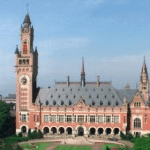
peacepalacethehague

Peace Palace, The Hague

Seat of the International Court of Justice

“The business of America is not business. Neither is it war. The business of America is justice and securing the blessing of liberty.” (20th-century U.S.-editor, commentator, and columnist George F. Will)

“And this nation, for all its hopes and all its boasts, will not be fully free until all its citizens are free.“ (John F. Kennedy, television address, 11 June 1963)

The paradox inherent in the United States’ commitment to the values of justice, liberty, and democracy on the one hand, and the often unforeseen and problematic results of enforcing and/or imposing these values on the other, has shaped the nation’s history domestically as well as internationally since independence.

At a domestic level, the U.S. was one of the first nations in modern history to establish a democratic and egalitarian form of government based on the Enlightenment principles of equality, political and civil liberties, and freedom of speech. At the same time, many of these principles have had different meanings for different groups within the U.S. throughout its history, and have repeatedly led to violent internal racial, ethnic, gender, and class conflicts.

In the arena of foreign policy Theodore Roosevelt’s “Corollary to the Monroe Doctrine” (1904) , for example, officially consolidated the role of the U.S. as an “international police power,” prepared to intervene “in flagrant cases of . . . wrongdoings.” This set the stage for a wide range of interventions, including those in Latin America and, more recently, the Middle East, whose transgressive nature has since met with harsh criticism. Yet the U.S. engagement in Europe during and after WWII has equally thrown into relief the nation’s crucial role as liberator and international promoter of justice and democracy.

The EAAS 2014 conference on “America: Justice, Conflict, War” will be hosted in The Hague (The Netherlands), the “City of Peace and Justice” that is home to the International Criminal Court as well as the International Court of Justice. Bringing Americanists from across Europe and across the globe to this location highlights the fact that many of the challenges facing the U.S. today increasingly tend to be, as Madeleine Albright has remarked in a recent interview, reflections of complexly interrelated problems of global justice and international peace diplomacy that transcend the boundaries of individual nation states and render the importance of international cooperation more crucial than ever.

We invite workshops that address the topics of justice, conflict, war, from the perspective of any of the disciplines within American Studies. Potential workshop themes may include but are not restricted to: questions of justice, domestic conflicts or international wars from the (pre-)colonial times to the present, including relations to Native Americans, slave revolts, race, class, gender and religious conflicts; conflicts between labor and capital, WWI and II, the Cold War, Vietnam, the First Gulf War, Afghanistan, 9/11, Iraq, the war on terror, and the war on drugs; violent responses to immigration and the militarization of the U.S.-Mexico border; the past / present role of the U.S. in the international community (UN, International Court of Justice, International Criminal Court, NATO); representations of justice, conflict, war in literature, film, and other media; war as cultural misunderstanding; war trauma, etc.

Registration fees

EAAS member € 140; late € 160; one day € 80

Non-member   €  160; late € 180; one day € 90

Student member € 70; late € 80; one day € 40

Student non-member € 85; late € 100; one day € 50

Gala dinner € 70


Registration fees include: Participation in all workshop sessions and plenary lectures, two receptions, conference packet, coffee/tea


Deadlines:

March 15, 2013: Deadline for online submission of workshop and parallel lecture proposals to include a one-page abstract (no more than 500 words) and a half-page c.v. (250 words) of potential workshop chairs and parallel lecturers. Parallel lecturers should be scholars of established reputation. Workshop chairs from the 2012 Izmir conference cannot be workshop chairs in The Hague. The EAAS Board decided at its Izmir meeting that henceforth all workshops must be chaired by two colleagues belonging to different constituent organisations. Please use EAAS-L to circulate your ideas if in need of a co-chair. Workshop and parallel lecture proposals, whose proposed topic should be presented very clearly within the space of 500 words, will undergo blind review, and be assessed by the Board on the following criteria, each of which will carry the same weight: 1) relation to conference theme; 2) originality and strength of proposal; 3) likelihood of attracting papers and audience; 4) other considerations (general impression of the proposal; scholarship; extent to which the discipline has been represented at EAAS conferences previously; etc.).

Proposers of workshops are required to use the form that can be found at: http://tinyurl.com/8mh4ox2

Proposers of parallel lectures are required to use the form that can be found at: http://tinyurl.com/8mjm57q

Please do not submit proposals for individual workshop papers at this time. Such proposals may be sent to the selected workshop chairs who will be announced in May 2013.

May 1, 2013: announcement of workshops selected for the conference; publication of CFP for individual workshop papers on EAAS website.

October 1, 2013: Workshop paper proposals (with one-page abstract; no more than 500 words) to be sent to Workshop Chairs by those proposing individual papers. 
October 15, 2013: Deadline for workshop chairs to send the tentative list of speakers and titles of workshop papers to the EAAS Secretary-General. 
January 15, 2014: Deadline for submitting FINAL titles of papers and names and addresses of confirmed speakers to the conference organizers. 
February 3, 2014: Deadline for information to be included in the 2014 biennial conference program.

[April 3-6, 2014: EAAS Conference takes place in The Hague]

April 20, 2014 (two weeks after end of conference): Deadline for chair 1 to send titles of two papers proposed for possible inclusion in conference volume (with speaker details) to Secretary-General.

April 20, 2014 (two weeks after end of conference): Deadline for chair 2 to send 500-word workshop report to the EAAS Secretary General, Gert Buelens, at secretary-general@eaas.eu.


Download as a word doc

Symposium: 22 and 23 August 2013, Liverpool Hope University, UK
Symposium Directors: William Blazek (Liverpool Hope University) and Laura Rattray (University of Glasgow)
Call for Papers:
2013 marks the 100th anniversary of the publication of Edith Wharton’s much-read and much-analyzed novel The Custom of the Country. Described as the writer’s “greatest book” by Hermione Lee in her 2007 biography, and listed by Wharton herself at the end of a long and prolific career as one of her own favourite works, The Custom of the Country arguably remains the author’s most complex and controversial novel.
To mark its centenary year, the symposium directors warmly invite papers on any topic pertaining to this landmark text. Themes might include: re-readings of the novel in the light of modern economic crises, serialisation, marketing and material culture, narrative strategies, modernist aesthetics, the challenges and rewards of teaching the novel, and reappraisals of Wharton’s most controversial female protagonist, Undine Spragg. Alternatively, discussions might be framed within the contexts of leisure-class marriage and divorce, masculinity, Europe, travel, or the visual arts. We also welcome broader comparative approaches, viewing The Custom of the Country in relation to other novels of the period, to other work by Wharton in any genre, or exploring the novel’s influence on contemporary writers and popular culture.
Co-sponsored by the Edith Wharton Society, the symposium will be held on the Hope Park campus of Liverpool Hope University, located within five miles of the Liverpool city centre. Moderately priced, ensuite campus accommodation will be available to delegates for the duration of the symposium. Day rates are also available. Keynote speakers for this event will be confirmed shortly. Further information and updates can be found on the symposium website: www.hope.ac.uk/custom<https://legacy.campus.gla.ac.uk/owa/redir.aspx?C=K3nCyLZDgEu7hbI843rlGYtCTAZg3c9IYpFsGwH01mjPczeZGW85hh2LRkcxqNuZbFxFIQsm0o8.&URL=http%3a%2f%2fwww.hope.ac.uk%2fcustom>
Please send 250-word abstracts for 20-minute papers (indicating any equipment/technical requirements), and a brief biographical note by the deadline of 15 April 2013 to the directors via e-mail: custom@hope.ac.uk
Sponsors: Liverpool Hope University and the Edith Wharton Society

The IAAS postgraduate and early career scholar conference will take place in Trinity College, Dublin on 19 January 2013. Proposals are invited for 20-minute presentations from across the disciplines of American Studies.

This year’s theme is Transnational America(s). Suggested topics include but are not limited to

–                Exile, Migration, Expatriation and the “Exilic”

–                Heterotopia

–                Borderland Studies

–                Transnational Identity

–                Transnationalism and Empire

–                Sovereignty and Globalisation

–                Comparative Imperialisms/Exceptionalisms

Proposals should be submitted to iaas.symposium@gmail.com by 31 December.

Full Call for Papers here: IAAS Symposium CFP 2013 (2)